 3 min read
 82
82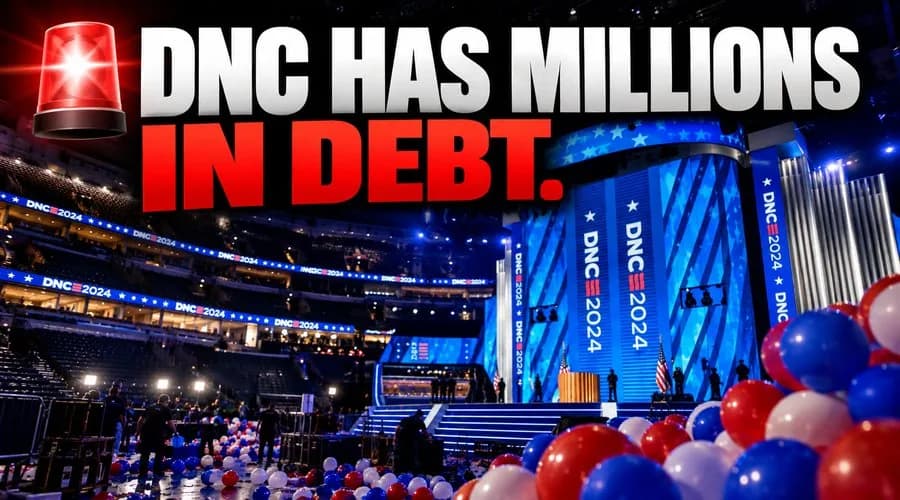
 Linkedin
 Threads
 Facebook
 X
X
The Democratic Party is talking about taking control of Congress. Its national headquarters, meanwhile, owes more money than it has in the bank.
That is not an accusation from a Republican commentator. Those are the numbers reported to the Federal Election Commission.
As of August 31, 2026, the Democratic National Committee reported $16.9 million in cash and $17.6 million in outstanding debt.
The Republican National Committee?
$125.6 million in cash. Zero reported debt.
That means the RNC entered September with more than seven times the cash available to its Democratic counterpart.
And just three weeks before the midterm elections, that financial difference deserves considerably more attention than another political forecast predicting a Democratic tsunami.
But the numbers are only the beginning.
A viral social-media post by political commentator Gentry Gevers has raised an even more provocative question: Did President Donald Trump accomplish something far more consequential than cutting government spending? Did his administration also disrupt a financial ecosystem connected to progressive political activism?
The question deserves investigation because it connects three major developments: the DNC's financial difficulties, the dismantling of USAID, and mounting scrutiny surrounding Democratic fundraising platform ActBlue.
Democrats Borrowed $15 Million. Republicans Built a War Chest.
The DNC's problems did not begin this October.
Federal records show that the organization borrowed $15 million in October 2025, a decision Democratic leadership defended as an investment in electoral operations and competitive races.
Borrowing for campaign operations is legal, and taking out a loan does not automatically mean an organization is insolvent.
But the financial contrast is difficult to ignore.
Between January 2025 and August 2026, the DNC reported approximately $228 million in receipts while spending more than $233 million.
The RNC, during the same period, collected approximately $316 million and reported substantially greater cash reserves.
For a political organization, money is not merely an accounting figure.
It finances voter-contact operations, advertising, research, field offices, legal teams, communications, and the infrastructure necessary to reach millions of Americans.
That is why the $108 million difference in available cash between the national committees matters.
It does not mean Democrats have stopped raising money. Their congressional campaign committees and allied organizations maintain separate fundraising operations.
But it reveals a striking imbalance at the national-party level.
If Democrats are preparing for an overwhelming victory, why is their national committee entering the final weeks carrying more debt than cash?
Trump Dismantled USAID. What Happened to the Nonprofit Money?
Now consider another development.
In March 2025, Secretary of State Marco Rubio announced the cancellation of approximately 5,200 USAID contracts and programs, representing roughly 83% of the agency's operations.
By July 1, USAID had ceased operating as an independent foreign-assistance administrator, with remaining programs transferred to the State Department.
The administration described the restructuring as an effort to eliminate waste and redirect foreign assistance toward measurable American national interests.
But USAID's funding history opened another debate.
For years, American taxpayer dollars supported a network of nongovernmental organizations administering international development, governance, healthcare, and civil-society initiatives.
Some of those organizations also maintained relationships with progressive advocacy networks.
Consider the Tides Center.
Congressional Republicans highlighted approximately $27 million in historical USAID-related funding connected to the organization.
Tides itself acknowledged administering roughly $26.7 million in USAID grants and subawards over several years, primarily for international civil-society and governance initiatives.
The organization also denied using those grants to finance domestic activist organizations.
This distinction is critical: receiving federal grants for international projects does not establish that the money financed Democratic election campaigns.
No documented financial trail has demonstrated that eliminating those USAID grants caused the DNC's present debt.
Nevertheless, a legitimate accountability question remains.
When organizations receiving taxpayer funds also participate in broader political and advocacy ecosystems, how effectively can the public trace the original money and verify that it was used exclusively for its authorized purpose?
That question should apply to conservative and progressive nonprofits alike.
And it is precisely the kind of examination that government spending reform should encourage.
ActBlue: The Next Financial Investigation
The most politically sensitive part of this story involves ActBlue, the online fundraising platform used by Democratic candidates and progressive organizations.
Unlike the allegations surrounding USAID, congressional scrutiny of ActBlue is well documented.
On September 16, 2026, Republican-led House committees released another investigative report examining the platform's procedures for preventing potentially illegal foreign political contributions.
Investigators described weaknesses in ActBlue's earlier passport-verification process, including reliance on information that was not independently authenticated against government records.
The committees also examined internal compliance concerns and the departure of legal personnel.
ActBlue CEO Regina Wallace-Jones invoked her Fifth Amendment rights during congressional questioning.
That constitutional decision is not proof of criminal misconduct.
ActBlue has disputed the committees' conclusions, presenting an outside review that it says supports the accuracy of its previous statements to Congress.
Then, on October 4, ActBlue announced enhanced verification procedures requiring certain overseas donors to submit a photograph of their U.S. passport and a contemporaneous image for identity verification.
The timing is significant.
After years of questions about political donation safeguards, one of America's most important Democratic fundraising platforms is operating under intensified congressional examination and has strengthened its verification procedures.
That is a meaningful development.
But it is not the same as proving that ActBlue knowingly financed campaigns with illegal foreign contributions.
Nor has its fundraising operation stopped. Federal filings show that ActBlue's political committee processed more than $2.2 billion in receipts during the current election cycle through August, much of it subsequently distributed to campaigns and political organizations.
The infrastructure remains substantial.
The investigation must therefore determine whether specific violations occurred, how extensive they were, and whether existing safeguards adequately protect the integrity of American political financing.
Three Developments. One Unanswered Question.
Here is what makes the timing so interesting.
The DNC has substantially less cash than the RNC.
The Trump administration has dismantled most of the former USAID funding structure.
And ActBlue, a central fundraising platform for Democratic campaigns, is facing congressional scrutiny while introducing stronger identity controls.
Those developments are real.
But connecting them requires more than placing three financial figures beside one another.
To establish that taxpayer funding improperly supported Democratic campaigns, investigators would need evidence tracing particular government payments into prohibited political expenditures.
That evidence has not been publicly established.
Still, I believe there is a larger political lesson here.
For decades, Americans have examined campaign donations primarily through the lens of wealthy individuals and corporations.
But the modern political economy is considerably more complicated.
It includes nonprofit organizations, fiscal sponsors, advocacy networks, digital fundraising platforms, independent political committees, consultants, and government contractors.
Money can move through multiple legal entities before it produces a recognizable political message.
That complexity makes transparency essential.
And when federal grants, political advocacy, and election fundraising exist within overlapping institutional networks, the public has a legitimate interest in understanding exactly how each operates.
The most powerful consequence of the Trump administration's spending review may ultimately be a demand for a level of financial accountability that those networks have rarely faced from ordinary citizens.
The Real Question Before November 3
Democrats are promoting the possibility of a significant electoral wave. Republicans, meanwhile, possess a substantial financial advantage at the national committee level.
Neither fact guarantees an election result.
But the numbers challenge the idea that Democratic momentum is equally strong across every dimension of the campaign.
The national party must still finance its operations, support candidates, organize voters, and compete against a Republican fundraising structure entering the final weeks with far greater cash reserves.
Meanwhile, Americans are entitled to answers about the integrity of political contributions and the proper use of taxpayer funds.
If Washington can track a family's income to collect taxes, it should be capable of tracking government grants and political donations with equally serious scrutiny.
That is not a partisan demand. It is a basic standard of financial accountability.
The DNC's debt is documented. The Republican financial advantage is documented. USAID's restructuring happened. The ActBlue investigations are ongoing.
What remains unproven is the allegation that these developments constitute the destruction of a secret taxpayer-funded Democratic campaign pipeline.
But the documented story is already consequential.
Washington's political machinery depends on money. And when the money becomes the story, Americans have every right to follow it—to its source, through every intermediary, and ultimately to the people who benefit.
The Democrats are talking about a tsunami that may not happen. Their financial disclosures are telling Americans to examine something else: the dismantled machinery behind the wave.