 3 min read
 26
26
 Linkedin
 Threads
 Facebook
 X
X
President Donald Trump returned to Arizona this week with an economic story that extends far beyond a presidential visit: billions of dollars in advanced manufacturing investment, new federal tax relief, sharply reduced border apprehensions, and infrastructure projects designed to support the state's long-term growth.
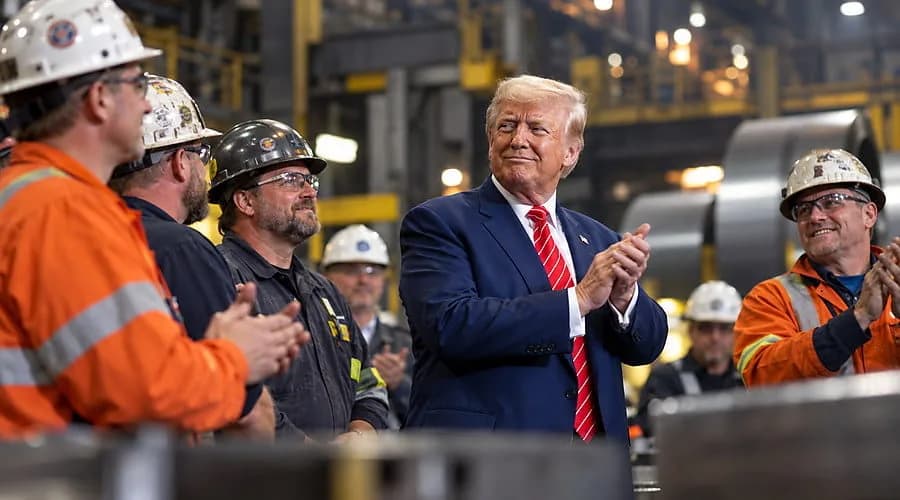
During his October 14 visit to Bullhead City, the administration highlighted major developments in industries that will help define America's economic future, including semiconductors, critical minerals, and precision manufacturing.
The largest investment is extraordinary. Taiwan Semiconductor Manufacturing Company, or TSMC, has announced plans totaling $265 billion in Arizona, including a major expansion unveiled in July 2026.
At the same time, the White House is pointing to tax benefits for an estimated 1.3 million Arizona seniors, significant reductions in border apprehensions, and new federal funding for water infrastructure.
These developments represent different parts of a broader economic strategy.
Advanced factories require dependable energy and water. Businesses depend on skilled workers and secure supply chains. Families benefit from employment opportunities, safer communities, and tax policies that allow them to retain more of their earnings.
Understanding those connections reveals why Arizona has become such an important state in America's industrial transformation.
Arizona Is Becoming a Global Center for Advanced Chips
The most significant economic development is taking place around Phoenix.
In July, TSMC announced an additional $100 billion investment in Arizona, bringing its total planned investment in the state to approximately $265 billion.
According to the Arizona Commerce Authority, the expansion envisions ten semiconductor fabrication plants, two advanced packaging facilities, and a research and development center.
These are among the most sophisticated industrial facilities in the world.
Semiconductors are essential components in artificial intelligence systems, automobiles, advanced medical equipment, communication networks, smartphones, and military technology.
For decades, American technology companies have designed many of the world's most important chips while relying heavily on overseas factories to manufacture the most advanced versions.
Expanding production on American soil strengthens domestic manufacturing capacity and gives technology companies another source of advanced chips closer to home.
It also creates an industrial ecosystem.
A semiconductor factory needs highly trained engineers and technicians, but it also depends on electricians, construction workers, logistics providers, equipment manufacturers, maintenance specialists, and suppliers of specialized materials.
Those businesses, in turn, support restaurants, housing, transportation services, and other parts of the local economy.
A massive investment therefore creates opportunities extending well beyond the boundaries of the factory itself.
The Trump administration has made domestic industrial expansion a central part of its economic strategy, using tax policy, trade negotiations, investment promotion, and manufacturing incentives to encourage production in the United States.
Arizona's semiconductor development also builds on years of earlier federal, state, and private investment, including the CHIPS Act and Arizona's established semiconductor workforce.
The result is a growing concentration of advanced manufacturing capabilities with implications for both Arizona and the national economy.
Thousands of Opportunities Beyond Semiconductor Factories
TSMC is only one part of Arizona's industrial expansion.
The White House identified several additional private-sector projects in its October 14 announcement.
Amkor Technology is developing a $2 billion advanced semiconductor packaging and testing facility in Peoria, with approximately 2,200 projected jobs.
EVelution Energy is developing an $850 million cobalt processing facility in Yuma County. The administration associates the project with approximately 3,300 jobs.
Hadrian is establishing a $200 million manufacturing and software hub in Mesa, with 350 expected positions.
Cyclic Materials is also developing a $20 million commercial facility in Mesa focused on recovering valuable materials.
These projects contribute different capabilities to America's industrial base.
Semiconductor manufacturing produces advanced chips. Packaging and testing prepare chips for use in electronic systems. Critical-mineral processing helps supply materials needed by modern industry.
Precision manufacturing supports complex equipment and components.
Together, the projects illustrate how a state can develop interconnected industrial capabilities rather than depending on one company or industry.
The employment figures are associated with the companies' development plans and announcements, with individual projects at different stages of construction and operation.
For Arizona workers, these developments create pathways into manufacturing, engineering, skilled trades, software development, and industrial services.
For entrepreneurs, they can open opportunities to serve a growing network of major manufacturers and their suppliers.
Tax Relief That Reaches Arizona's Seniors
Industrial investments help build tomorrow's economy. Tax policy can also influence what families have available to spend today.
The White House estimates that approximately 1.3 million Arizona seniors may benefit from the additional federal deduction established under the Working Families Tax Cuts.
Under IRS rules, eligible taxpayers aged 65 and older may claim an additional deduction of up to $6,000, or $12,000 for married couples filing jointly when both spouses qualify.
The provision applies from 2025 through 2028 and begins phasing out at higher income levels.
For retirees managing housing costs, medication, groceries, insurance, and utility bills, reducing federal income tax liability can be meaningful.
Consider a married retired couple living on a combination of Social Security and other retirement income.
If both spouses qualify, the additional $12,000 deduction can reduce the portion of their income subject to federal income tax. Their actual savings depend on their income and tax circumstances.
The deduction does not eliminate the taxation of Social Security benefits for every recipient, but it can provide additional federal tax relief to qualifying households.
The White House also reports that Arizona taxpayers received average refunds of $3,659 during the 2026 filing season.
Those refunds reflect individual tax circumstances, including withholding and credits, rather than a uniform benefit paid to every household.
The broader economic objective is straightforward: allowing eligible workers and retirees to retain more after-tax income can support household budgets and local consumer spending.
That matters particularly in retirement communities, where many residents depend on relatively predictable sources of income.
A Stronger Border Has Economic Consequences
Arizona also occupies a central position in national border-security policy.
According to figures cited by the White House, southwestern border apprehensions in August 2026 were approximately 94% below the monthly average recorded during the Biden administration.
The administration also reported 16 consecutive months without Border Patrol releases of apprehended migrants into the country under the policy category it tracks.
These figures describe a substantial shift in border-enforcement outcomes.
The federal government has also allocated $46.5 billion for border-wall construction and related infrastructure through the Working Families Tax Cuts legislation.
In Yuma County, 285 acres of public land were transferred to the Department of the Navy to establish a National Defense Area supporting border operations.
The economic importance of border management reaches beyond law enforcement.
Arizona businesses rely on legitimate international commerce, including goods moving through ports of entry and commercial relationships with Mexico.
Reliable border operations can support predictable trade, while coordinated enforcement and legal transportation systems serve different but complementary purposes.
For families living in border communities, public safety and the orderly operation of border crossings have immediate significance.
The Trump administration has made enforcement a defining priority, and the decline in reported apprehensions is one of the clearest measurable changes presented during the Arizona visit.
Falling Crime Means More Confidence for Communities
Public safety also plays an important role in the state's economic story.
According to Arizona Department of Public Safety figures cited by the White House, reported violent crime fell approximately 13% statewide in 2025 compared with 2024.
The reported declines included 13% fewer homicides, 24% fewer robberies, and 11% fewer aggravated assaults.
Preliminary figures for the first half of 2026 also showed declines in major cities.
Phoenix recorded a 22% reduction in homicides and a 19% decrease in robberies compared with the same period the previous year.
Mesa recorded a 33% homicide decline, while Tucson reported a 24% decrease.
The figures document improvements across the specified reporting periods; the individual contributions of federal, state, and local policies require separate analysis.
For residents, the importance of lower crime is easy to understand.
A safer neighborhood can mean greater confidence walking outdoors, taking children to local activities, or keeping a small business open.
Businesses also consider safety when selecting locations, hiring workers, and expanding operations.
Public safety therefore belongs in the conversation about economic development because it influences the environment in which families and enterprises operate.
Water Infrastructure Is Part of Arizona's Industrial Future
Arizona's next generation of industrial development will require more than private investment.
It will also require infrastructure capable of supporting businesses, workers, and growing communities.
Water is especially important.
The White House highlighted a $179 million federal investment announced in July 2025 for the North Gateway Advanced Water Purification Facility in Phoenix.
The project is designed to expand advanced water treatment capacity.
The administration also finalized 18 short-term conservation agreements with Colorado River water users in Arizona and California.
These efforts connect directly to the state's economic ambitions.
Semiconductor manufacturing requires reliable supplies of highly purified water. Growing communities need dependable municipal systems. Agriculture depends on access to water for production.
Investments in treatment technology and conservation can help communities manage those overlapping demands.
For families, modern infrastructure also supports the reliability of essential services.
For businesses, it contributes to confidence that industrial development can continue over the long term.
Arizona's water projects demonstrate why economic growth is not simply a matter of persuading companies to invest. Public infrastructure must also support the investment those companies are prepared to make.
The Larger Strategy: American Technology, American Workers, American Strength
What connects semiconductors, critical minerals, tax policy, border enforcement, public safety, and water infrastructure?
They influence the conditions under which American businesses operate and families build their futures.
Modern factories require stable infrastructure and skilled labor. Workers need opportunities to develop technical capabilities. Growing communities need safe neighborhoods and reliable essential services.
Advanced manufacturing also has national-security implications.
Artificial intelligence, communications networks, defense systems, and precision-guided equipment all depend on sophisticated semiconductor technology.
Expanding domestic production can reduce certain supply-chain vulnerabilities and strengthen America's capacity to manufacture strategically important components.
The Trump administration has emphasized these objectives through its broader policies on industrial investment, energy, trade, and technological competitiveness.
Arizona provides a concrete example of how those priorities intersect with existing industrial development and substantial private-sector commitments.
The long-term opportunity is considerable.
A student entering high school today could eventually work in semiconductor engineering. A family-owned electrical contractor could serve a growing industrial customer base. A technical college could develop new training programs in response to manufacturers' workforce needs.
These are the downstream effects that make industrial expansion relevant to people who may never set foot inside a semiconductor fabrication plant.
Arizona's Next Chapter Is Already Taking Shape
President Trump's Arizona visit brought together developments that are often discussed separately.
A major semiconductor expansion is advancing the state's role in high-technology manufacturing. Additional investments are developing processing, packaging, and precision-production capabilities.
Federal tax provisions provide new deductions for qualifying seniors. Border-enforcement statistics show substantial changes. Reported violent crime has declined across measured periods, and water infrastructure investments are supporting the state's future needs.
Each development has its own timeline, responsible institutions, and measurable outcomes.
Together, they reveal why Arizona has become increasingly important to the national discussion about manufacturing, economic opportunity, and technological leadership.
The next decade will require continued investment in workers, education, infrastructure, and the industrial systems that support a modern economy.
Federal, state, and local officials will all have responsibilities in shaping those conditions, alongside the businesses making long-term commitments.
For Arizona families, the opportunity is larger than any individual presidential visit.
It is the possibility of living in a state where advanced industries create new careers, small businesses find new customers, retirees benefit from available tax relief, and communities possess the infrastructure needed for future growth.
Arizona's transformation is about more than billions of dollars. It is about building the people, industries, and capabilities that will help determine America's economic future.