
 3 min read
 8
8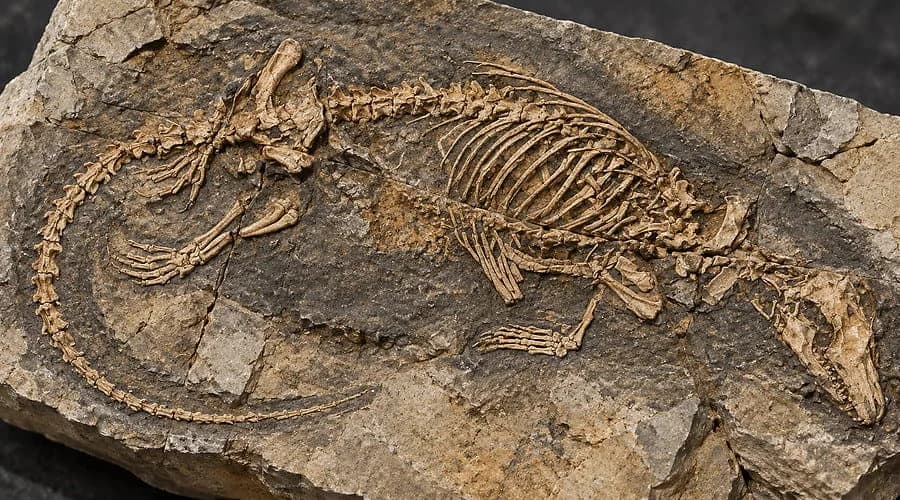
 Linkedin
 Threads
 Facebook
 X
X
A creature that lived approximately 165 million years ago may help scientists answer a surprisingly familiar question: When did the ancestors of modern mammals develop the ability to chew their food, swallow it efficiently, and nurse their young?
An international team of researchers has identified an exceptionally preserved fossil from Inner Mongolia, China, belonging to a previously unknown species named Megacauda sungei.
The animal lived during the Middle Jurassic, when dinosaurs dominated much of Earth's terrestrial ecosystems.
But Megacauda was no dinosaur.
It was an early mammal relative, roughly the size of a small dog, with a flattened tail suited for swimming, powerful hind limbs, and sharp teeth adapted for catching prey.
What makes the discovery extraordinary is not simply the creature's unusual appearance.
According to research published October 7 in the scientific journal Nature, the fossil preserves delicate anatomical structures in the throat that provide some of the earliest direct evidence of the biological machinery associated with mammalian swallowing and suckling.
The discovery suggests that some defining features of mammals developed much earlier in evolutionary history than the available fossil record had clearly demonstrated.
And it reveals that the ancestors and early relatives of modern mammals were considerably more diverse than their small size might suggest.
An Ancient Animal That Resembled Several Creatures at Once
The fossil was discovered in a region of northeastern China famous for exceptionally preserved prehistoric organisms.
Researchers named the new species Megacauda sungei, with Megacauda referring to its unusually large tail.
The animal weighed an estimated 1 to 2 kilograms, or approximately 2.2 to 4.4 pounds.
Although modest by modern standards, researchers describe it as the largest known mammaliaform from the Jurassic period.
Its anatomy presented an unusual combination of features.
The hind limbs resembled those of a modern platypus, while its broad, flattened tail suggested an ability to propel itself through water.
Its teeth, however, were considerably different from those of a living platypus.
They were adapted for cutting and shearing animal tissue, indicating a predatory diet.
Scientists believe Megacauda may have hunted small aquatic creatures, including salamanders, fish, and invertebrates, while possibly sheltering in burrows on land.
The researchers also identified small salamander remains associated with the fossil, supporting the interpretation that it consumed animal prey.
This combination of aquatic adaptations and specialized teeth suggests an animal capable of occupying an ecological niche that many people would not associate with mammals living alongside dinosaurs.
But the most important evidence was hidden inside its skull.
The Tiny Throat Bones That Changed the Story
One of the researchers examining the fossil was Zhe-Xi Luo, a paleontologist at the University of Chicago.
Luo noticed an unusually well-preserved collection of tiny throat bones known as hyoids.
In modern mammals, these structures help support the tongue and participate in the complex muscular coordination required for swallowing.
The team used advanced imaging techniques, including computed tomography and X-ray fluorescence spectroscopy, to investigate anatomical details that were difficult to distinguish in the dark fossil-bearing rock.
The resulting reconstructions revealed structures associated with the throat passage and the roof of the mouth.
Together, these features provided evidence that Megacauda possessed anatomical machinery resembling that used by modern mammals to process and swallow food.
This matters because mammals generally do not eat in quite the same way as many other vertebrates.
Instead of simply seizing and swallowing large pieces of food, most mammals use specialized teeth and coordinated tongue movements to break food into smaller portions before swallowing.
That process supports a remarkable variety of diets.
A wolf tearing meat, a cow grinding vegetation, and a human chewing bread all rely on variations of a shared biological system.
The fossil suggests important elements of that system were already present among early mammal relatives approximately 165 million years ago.
The Discovery Also Reveals Clues About Nursing
The implications reach beyond eating solid food.
The throat structures examined by the researchers are also associated with the ability of infant mammals to draw milk from their mothers.
Nursing requires precise coordination between the tongue, mouth, throat, and associated muscles.
That process is one of the defining biological characteristics of mammals.
Yet identifying when the necessary anatomy first evolved has been difficult.
Soft tissues such as muscles and glands rarely survive fossilization, leaving researchers dependent on indirect anatomical evidence.
The exceptional preservation of Megacauda offers a rare opportunity to examine the structures that supported these functions.
The research team concluded that anatomical adaptations associated with suckling and mammalian-style swallowing were present among early mammal relatives by the Middle Jurassic.
However, the fossil does not directly show an infant nursing or prove precisely how Megacauda fed its offspring.
The conclusion comes from anatomical reconstruction and comparison with living mammals.
That distinction is important because fossil evidence reveals physical structures more readily than the exact behaviors of long-extinct animals.
Nevertheless, the discovery provides significant new information about when these biological capabilities may have emerged.
The Age of Dinosaurs Was More Diverse Than We Imagined
Popular depictions of prehistoric life often portray the Jurassic as a world belonging almost exclusively to enormous dinosaurs.
Early mammals, meanwhile, are frequently imagined as tiny, frightened creatures hiding in the shadows.
The fossil record increasingly reveals a more complicated picture.
By the Jurassic, mammal relatives had already developed a surprising variety of adaptations.
Some lived in trees. Others dug underground, moved across the ground, or developed features associated with swimming.
Megacauda adds another important example.
Its body suggests that some early mammal relatives were already exploiting aquatic environments and developing specialized ways to capture food.
This challenges the assumption that mammalian ecological diversity began only after the mass extinction that eliminated non-avian dinosaurs approximately 66 million years ago.
Modern mammals did diversify dramatically after that event.
But the foundations for many forms of mammalian specialization were already developing much earlier.
Mammals were not waiting for the dinosaurs to disappear before evolution began producing remarkable adaptations.
They were experimenting with different ways of living while dinosaurs still dominated the planet.
What Scientists Know—and What They Still Cannot Prove
The discovery is significant, but it does not settle every question about mammalian evolution.
The fossil belongs to an extinct group called docodonts, members of a broader evolutionary lineage known as mammaliaforms.
These animals were close relatives and evolutionary predecessors of modern mammals, but Megacauda should not be described as a direct ancestor of humans.
Researchers can reconstruct important relationships from skeletal features, yet identifying a particular fossil species as the direct ancestor of a modern lineage is usually much more difficult.
There is also uncertainty surrounding the precise timing of biological innovations.
Finding a feature in an animal that lived 165 million years ago establishes that the feature existed by that period.
It does not establish that the feature first appeared at that moment.
The underlying adaptations could be considerably older.
The research therefore provides a new minimum age for important aspects of mammalian feeding anatomy rather than identifying an exact evolutionary starting point.
Independent researchers have welcomed the fossil's exceptional preservation while recognizing that additional anatomical comparisons and discoveries will help refine the interpretation.
This is how paleontology advances.
A new fossil can provide evidence that changes existing explanations, but subsequent research determines how completely that evidence fits into the larger history of life.
Why a Tiny Fossil Can Matter So Much
Unlike medical or technological breakthroughs, paleontological discoveries do not usually promise immediate improvements in everyday life.
Their value lies somewhere different.
They help humanity understand how complex biological systems developed and how ancient organisms adapted to changing environments.
The mammalian ability to process food efficiently supported the evolution of increasingly diverse diets and lifestyles.
The ability to nurse offspring helped establish a reproductive strategy that remains central to mammalian biology.
Understanding the ancient anatomical foundations of those traits helps scientists reconstruct the evolutionary history connecting creatures as different as whales, bats, elephants, and humans.
The discovery also demonstrates the importance of scientific technology.
Without modern imaging systems, delicate structures preserved within the fossil might have remained difficult to recognize.
Advanced instruments allowed researchers to recover biological information from rock that had preserved an animal for more than 160 million years.
In this case, technological innovation did not merely help scientists look farther into space or deeper into living cells.
It allowed them to investigate a moment in Earth's distant past.
The Biggest Discoveries Sometimes Come From the Smallest Evidence
The discovery of Megacauda sungei is a reminder that scientific importance is not determined by physical size.
The animal was tiny compared with the dinosaurs that shared its world.
Yet the preservation of a few delicate bones in its throat has provided evidence relevant to the evolutionary history of an entire group of animals.
Its anatomy reveals an ancient swimmer and predator with an unexpectedly sophisticated feeding system.
More importantly, it helps explain how biological capabilities familiar to every human being may have originated deep in prehistoric time.
Scientists will continue debating the exact evolutionary sequence, and future discoveries may extend the timeline even farther into the past.
But the central finding is already striking.
Long before modern mammals appeared, and while dinosaurs still ruled much of the planet, their early relatives had developed complex adaptations that would become fundamental to mammalian life.
Sometimes understanding humanity's place in the natural world does not require discovering something enormous. It requires recognizing the significance of something extraordinarily small, preserved for 165 million years.