


 3 min read
 23
 Linkedin
 Threads
 Facebook
 X

France, Frankfurt, Milan Are Burning: Radicalism, Open Borders, and a Nation Losing Control
A building that stood for more than 140 years was reduced to a burning shell in a matter of hours.
On October 17, masked rioters stormed the historic City Hall in Limoges, France, smashed windows, and set the 1883 building ablaze. Its roof and bell tower collapsed as firefighters struggled to save one of the city's most important architectural landmarks.
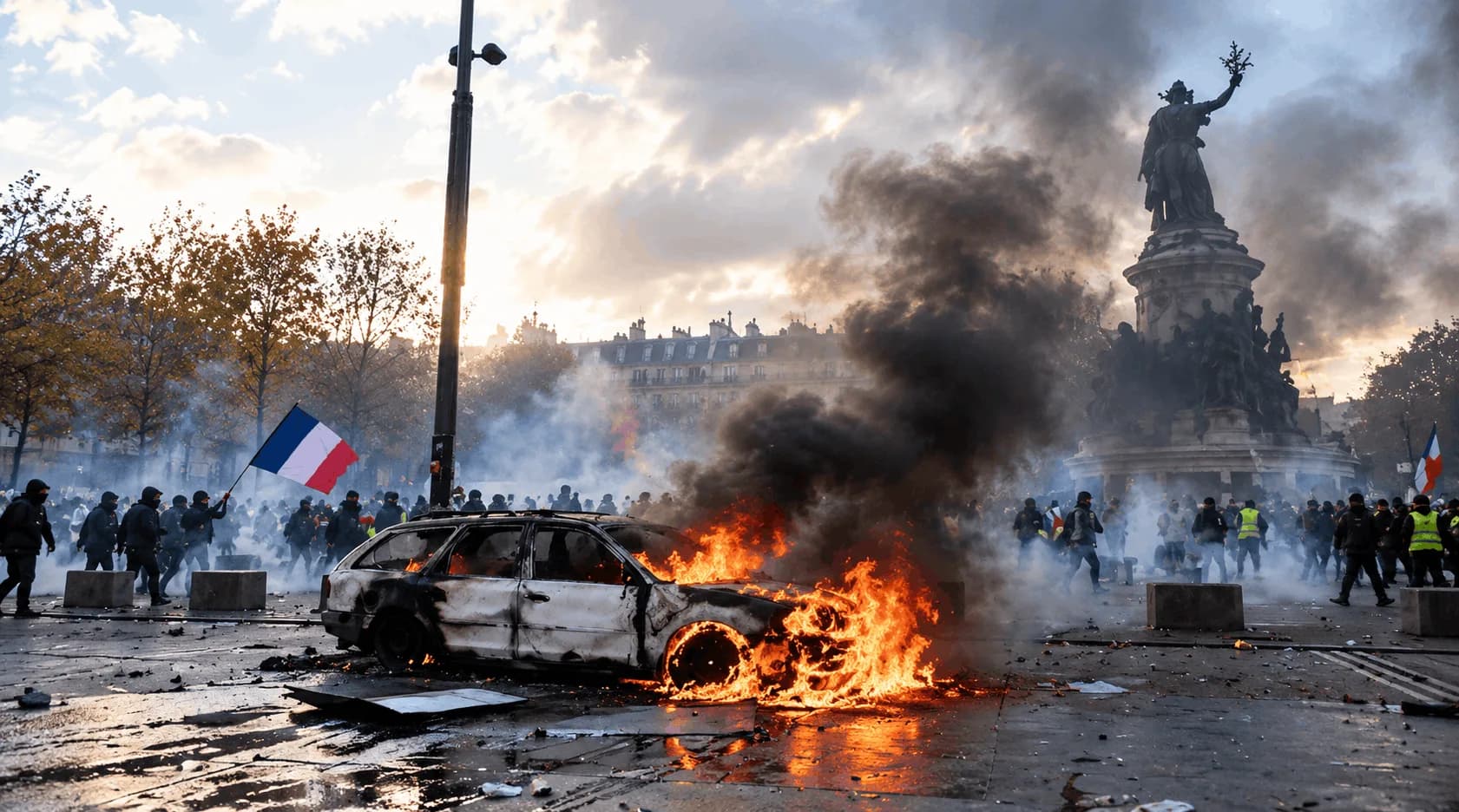
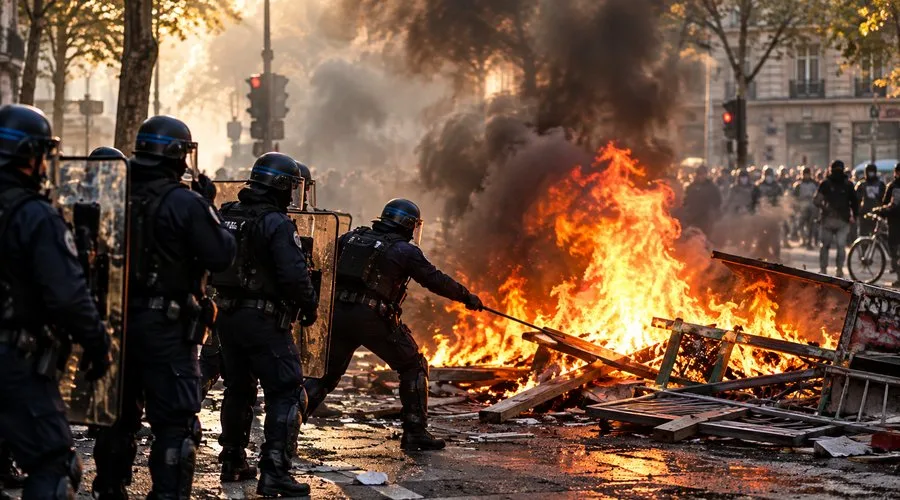
Across France, vehicles burned, businesses were looted, police officers were attacked, and government buildings became targets of organized violence.
And yet much of the international coverage began with a familiar explanation: students protesting inadequate schools and citizens frustrated by rising living costs.
Those grievances may explain why hundreds of thousands of people joined demonstrations. They do not explain away the criminal destruction of a nation's history, businesses, and public institutions.
France is facing something more serious than another political protest. It is confronting a crisis of public order, radicalization, and government authority.
The Destruction of France's Heritage
Approximately 550,000 people participated in demonstrations across France on October 17, according to Interior Minister Laurent Nuñez. Organizers estimated 800,000.
Most marched peacefully. But violent groups operating alongside the demonstrations transformed parts of Paris, Lyon, Marseille, and other cities into scenes of chaos.
By Sunday, approximately 2,400 people had been arrested. Thousands of businesses had reportedly been damaged or looted.
In Marseille, vandals entered City Hall and damaged a statue of Marianne, the symbolic representation of the French Republic.
In Lyon, a tourist office was set ablaze.
In Limoges, the destruction was particularly devastating.
Guillaume Guérin, the city's Republican mayor, accused organized ultra-left militants of preparing the attack. He said police lacked sufficient resources and were forced to retreat before the historic building was destroyed.
On October 20, authorities arrested a suspect connected to the arson investigation. French reporting identified him as an activist associated with the ultra-left who was already known to security services.
Counterterrorism investigators have also been brought into the case.
The suspect's reported political associations matter: the available evidence points toward violent far-left extremism, not an established jihadist operation. A counterterrorism investigation does not, by itself, establish religious motivation.
That distinction should not diminish the seriousness of what happened.
A country cannot preserve its civilization when organized extremists are able to destroy historic landmarks while its security forces struggle to maintain control.
France's Immigration and Jihadist Threats Are Real
The riots also arrive amid another national-security debate that European governments cannot afford to ignore: immigration enforcement, radical Islamism, and the security consequences of uncontrolled movement across borders.
This concern is not based merely on political rhetoric.
According to the European Commission's official records, France itself identified persistent jihadist threats, increasing antisemitic attacks, irregular-migration networks, and the possible infiltration of radicalized individuals among the reasons for maintaining temporary internal border controls through October 31, 2026.
Those controls have also been notified for a further six-month period beginning November 1.
That is an extraordinary admission about the security challenges facing one of Europe's most influential countries.
France participates in the Schengen system of European free movement, although it currently maintains certain internal border checks. It is therefore inaccurate to suggest France has literally abandoned every border control.
But the larger political question remains unavoidable.
What happens when immigration systems cannot consistently identify dangerous individuals, stop criminal smuggling networks, or enforce immigration laws effectively?
President Donald Trump has called on France to strengthen border security and regain control amid the unrest.
His warning reflects a broader concern about European migration and national sovereignty.
Still, French authorities have not established that immigrants or jihadist organizations orchestrated the October 17 riots. The documented border-security threats and the perpetrators of these particular attacks must be investigated on their own evidence.
A serious national-security argument does not need to confuse one extremist movement with another.
The Problem Goes Beyond Immigration
France's difficulties also reveal the dangers of violent political movements that reject democratic institutions.
For decades, radical anarchist and anti-capitalist groups have participated in violent confrontations with French authorities.
Some operate through loosely organized networks using tactics commonly associated with the Black Bloc: concealing identities, building barricades, attacking police, and targeting public or commercial property.
French officials have attributed significant portions of the latest violence to radical far-left groups and opportunistic criminals.
This creates a fundamental contradiction.
How can individuals claim to fight for economic justice while destroying businesses that employ ordinary French workers?
How does burning a public building improve education?
And who ultimately pays for the destruction?
Taxpayers, business owners, employees, insurers, and local communities.
Every destroyed business represents more than broken glass. It can mean lost wages, threatened jobs, interrupted livelihoods, and families struggling to recover.
Government failure becomes even more troubling when authorities already possess intelligence about individuals considered potential threats.
The arrest of a suspect reportedly known to French security services raises an urgent question: Were warning signs overlooked, or did police lack the resources to act?
President Emmanuel Macron has ordered an examination of intelligence and security failures surrounding the violence.
The French public deserves answers.
A Nation Has the Right to Defend Its Identity
France has one of the richest historical and cultural inheritances in the Western world.
Its cathedrals, monuments, architecture, literature, and political institutions represent centuries of civilization.
Protecting that inheritance is not extremism. It is a legitimate responsibility of government.
The same principle applies to immigration.
A sovereign nation has the right to determine who enters its territory, enforce its laws, remove individuals who have no lawful right to remain, and prosecute those who threaten its security.
It can also require everyone living within its borders to respect the constitutional order, religious freedom, and the rights of fellow citizens.
Respect for cultural identity and democratic government should never be negotiable conditions of living in a free society.
Radical Islamist movements that seek to replace constitutional freedoms with religious authoritarianism deserve unequivocal opposition. So do violent anarchist movements that seek to destroy public institutions.
These are different ideological threats. Both should be judged by their actual conduct and the evidence against those responsible.
Ordinary Muslims, peaceful immigrants, and lawful demonstrators cannot be presumed responsible for the crimes of violent extremists.
The obligation to respect France's laws applies equally to everyone.
America's Warning From France
Americans should pay attention because the questions confronting France are not exclusive to Europe.
How secure are national borders? How effectively are violent extremists identified? Can police protect citizens during mass demonstrations? And what happens when political leaders lose the public's confidence in their ability to enforce the law?
France's experience demonstrates the consequences when violence overwhelms the institutions responsible for public safety.
The destruction of Limoges City Hall should become a moment of national reckoning.
A society that cannot defend its historic landmarks, businesses, public servants, and ordinary citizens faces a serious crisis of authority.
France does not have to choose between improving its schools and protecting its streets. It does not have to choose between respecting legitimate immigrants and enforcing its borders.
It can do both.
The real question is whether its political leadership possesses the determination to restore order, confront every form of violent extremism, and defend the cultural and constitutional foundations of the nation.
France's heritage was built over centuries. It should not be surrendered to masked rioters, criminal networks, or ideological movements that reject the freedoms and institutions that make the country what it is.
A nation that cannot defend its streets will eventually struggle to defend its future.